

跳至主要内容

色觉辅助

语言 (11)

South Western RailwayWhooshSouth Western Railway × Whoosh · Operational Case Study

Transforming On-Board Reporting into Operational Intelligence

A South Western Railway One Scan Case Study (Tell Us Module · Nov 2024 – Nov 2026)

24-MONTH OPERATIONAL TELEMETRY

Legitimate passenger reports logged (Nov 2024 – Nov 2026)
1,800+
Reports automatically tagged to specific rolling stock units
1,553
End-to-end Class 444 graffiti detection & removal window
< 8 hrs
Faster resolution from context-rich reporting (RSSB T1161)
20–30%

CLASS 158 · CLASS 159 · CLASS 444 · STATIONS

01 · THE CHALLENGE

Closing the SQR & Complaint Latency Gap

South Western Railway operates one of the UK’s busiest commuter and regional networks, with a fleet spanning multiple unit classes and a Service Quality Regime (SQR) that demands rapid response to on-board defects. Issues such as HVAC failures, cleanliness shortfalls, vandalism, and PA faults have traditionally relied on formal complaint channels—capturing problems days or weeks after the fact, long after resolution windows have closed and SQR penalties have already landed.

The operational question South Western Railway faced was straightforward: how do you capture real-time operational intelligence from the passengers travelling the network every day?

02 · THE SOLUTION

One Scan “Tell Us” Real-Time Defect Routing

As part of South Western Railway’s One Scan information dashboard—developed and operated by Whoosh—the Tell Us module gives passengers a direct, frictionless channel to report on-board issues in real time. A single scan of a QR code on any seat, coach, or platform opens a pre-populated form, automatically tagged with the train unit, carriage, and sublocation. Reports are instantly categorised and routed to the relevant operational team.

The result is a live defect intelligence feed—built not from delayed formal complaints, but from passengers acting in the moment.

  1. 01Passengers scan a QR code on their seat, carriage wall, or station platform.
  2. 02A concise, pre-populated mobile form captures the issue, category, and exact sublocation.
  3. 03The report is dispatched in real time to the responsible team—Train Presentation, Station Operations, or Fleet Engineering.
  4. 04Every on-train report is tagged to a specific rolling stock unit, building a longitudinal fleet maintenance dataset.
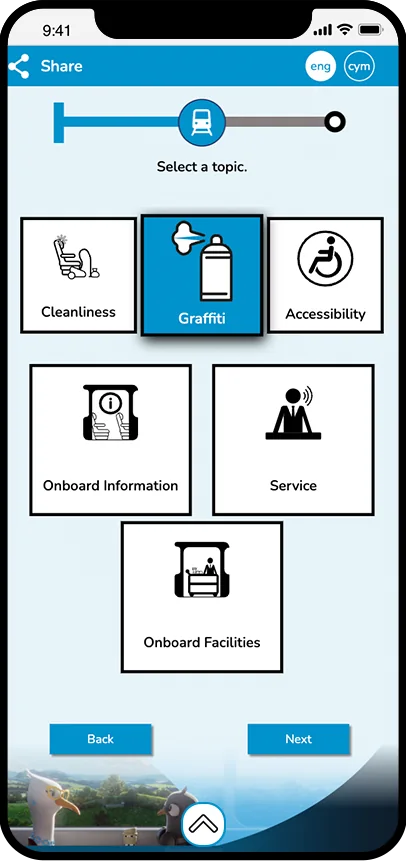
One Scan Tell Us mobile interface showing six issue categories with Graffiti highlighted
Step 1 · Passenger selects an issue category (Cleanliness, Graffiti, Accessibility, Information, Service, Facilities).
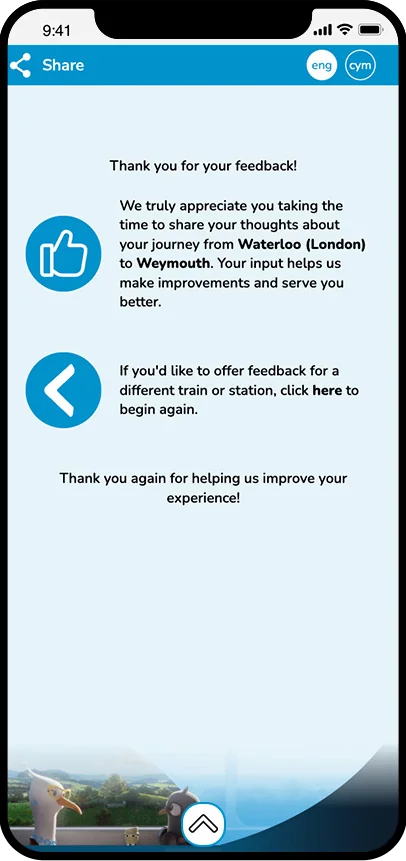
One Scan Tell Us mobile confirmation screen thanking the passenger on the London Waterloo to Weymouth service
Step 2 · Instant route-aware confirmation for the passenger’s Waterloo to Weymouth service.
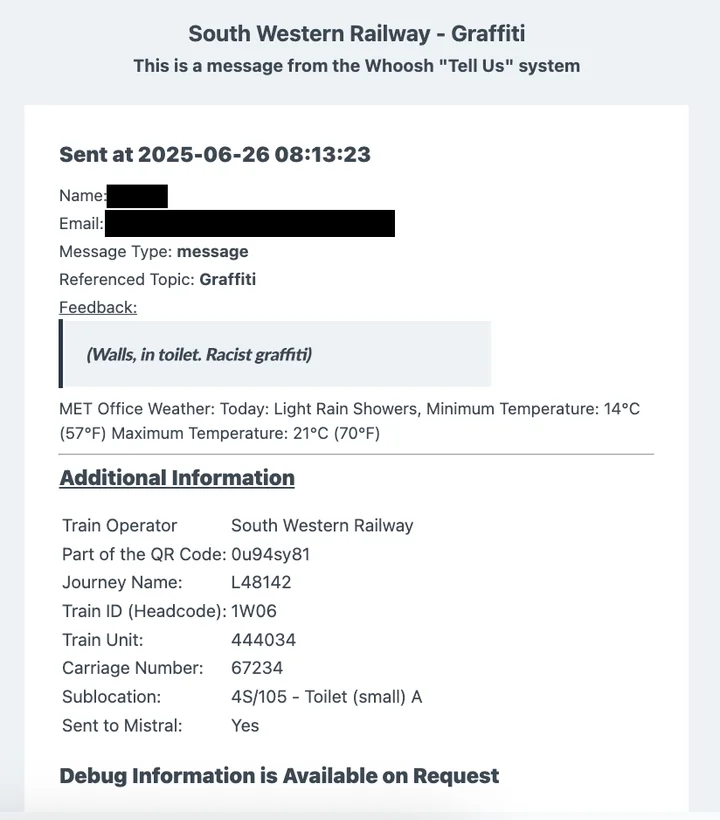
Automated Whoosh Tell Us dispatch message showing Train ID 1W06, Train Unit 444034, Carriage 67234, and Toilet sublocation metadata
Step 3 · Automated operational alert pre-tagged with Headcode 1W06, Unit 444034, Carriage 67234, and Toilet Sublocation.

03 · ONE SCAN IN ACTION

Three Operational Case Studies

CASE STUDY 01

Graffiti Detection and Same-Day Resolution

In June 2025, a passenger used One Scan to report racist graffiti discovered in a toilet aboard a Class 444 unit at approximately 08:00. The report—filed under the Graffiti category and automatically tagged to the unit—was received immediately by South Western Railway’s Train Presentation team.

By 11:40, the Head of Train Presentation had reviewed the report and mobilised a cleaning crew. Arrangements were made to intercept the service on its return to London Waterloo, and by 15:58 the graffiti had been removed. Resolution was confirmed internally at 16:06—within eight hours of the original report.

Without One Scan, this report would have been unlikely to surface through formal channels before the unit re-entered service.

  1. 08:00

    Report submitted via One Scan & routed to Train Presentation

  2. 11:40

    Head of Train Presentation reviews alert & mobilises cleaning crew

  3. ~16:00

    Service intercepted at London Waterloo; graffiti removed by 15:58

  4. 16:06

    Internal resolution confirmed — under 8 hours end-to-end

“One Scan is already allowing us to react faster to customer feedback. We had a team mobilised before the train returned to Waterloo.”

Tom Bartlett — Customer Experience Business Partner, South Western Railway
CASE STUDY 02

HVAC Failures — From Passenger Reports to a Fleet Business Case

During the summer 2025 heatwave periods, One Scan’s Tell Us module recorded over 90 temperature-related reports across the South Western Railway network. Each report was tagged to a specific rolling stock unit—creating a dataset that operational and engineering teams could analyse by fleet type, route, and frequency.

The data told a clear story. The Class 159 fleet accounted for 54% of all summer temperature reports—disproportionate to their share of the timetable. Across the peak heatwave months of June, July, and August, 24 individual Class 159 units generated temperature reports, with several units appearing multiple times across different services.

This pattern of repeat reports against identifiable units gave South Western Railway’s engineering team something a call-centre log could never provide: evidence-based, unit-level data strong enough to support a formal business case proposing solar-reflective roof coating on the most-affected Class 159 units.

of summer heat reports on Class 159 fleet
54%
individual Class 159 units flagged
24
temperature reports logged
90+
peak months: Jun, Jul, Aug 2025
3

“A great benefit of Tell Us reporting is that it automatically includes information that the customer wouldn’t know themselves (like carriage & train unit number). This enables targeted actions without delay.”

Tim Mears — CX Improvement Lead, South Western Railway
  • Individual passenger reports, aggregated over time, surface systemic engineering issues invisible to traditional feedback channels.
  • Unit-tagged reporting transforms anecdotal complaints into a quantitative case for rolling stock investment.
  • One Scan telemetry directly informs maintenance scheduling and capital planning.

“Higher-quality, context-rich fault reporting can reduce time to resolution by 20–30%” — RSSB Project T1161 & McKinsey Rail Digitalisation Report

CASE STUDY 03

PA System Faults — Capturing the Unreported & Recognising Staff

One Scan also surfaced recurring passenger experience failures that rarely reach the formal complaint threshold: inaudible, distorted, or absent on-board announcements. Across the 24-month period, Tell Us recorded more than 80 reports relating to PA and announcement quality—covering faulty tannoys, unclear split-train information, and absent communication during disruption, each linked to a unit ID and timestamp.

These reports reach operations teams in real time—before the train completes its journey, shifting operational response from reactive to preventative. Equally important, One Scan captures positive signal when guards communicate clearly during disruption:

“We’ve been stationary at Petersfield for half an hour without any announcement – no one knows whether to wait or abandon the journey.”

Passenger report · May 2026

“The announcements are coming through so quietly they can’t be heard – the train is delayed by almost an hour and no one knew what was going on.”

Passenger report · January 2026

“The guard did an amazing job – updates on delays, tube line status, engineering works. Everything I needed.”

Passenger commendation · March 2026

04 · VERIFIED TELEMETRY

24 Months of Operational Data

Recorded on South Western Railway’s One Scan Tell Us module between November 2024 and November 2026.

South Western Railway One Scan Tell Us operational data (November 2024 to November 2026)
MetricFigure
Total legitimate passenger reports (Nov 2024 – Nov 2026)1,800+
Reports linked directly to specific train units1,553
Cleanliness and toilet presentation reports660+
Temperature / HVAC reports242
PA and announcements reports80+
Unprompted staff commendations captured65+
Peak monthly submissions160 (July 2026)

05 · OPERATIONAL IMPACT

From Passenger Intent to Fleet Action

Reduced SQR Exposure

Defects captured and resolved within the same service window are far less likely to escalate into scoreable SQR failures. Real-time routing closes the gap between passenger experience and operational response.

Evidence-Based Maintenance Planning

Unit-level reporting aggregated over time identifies recurring offenders—directly informing capital investment decisions such as the Class 159 solar-reflective roof coating business case.

Staff Recognition & Accountability

Commendations and defect alerts arrive through the same channel, giving operations managers a balanced, evidence-based view of on-board service quality.

Passenger Trust

Passengers who can report an issue effortlessly in the moment are less likely to disengage—turning a frustrating journey event into structured operational action.

Conclusion

South Western Railway’s investment in the One Scan platform—and the Tell Us module at its core—has created an operational intelligence capability that did not exist previously: real-time, unit-tagged, categorised passenger intelligence captured at the point of experience.

Jack Shields — Managing Director, Whoosh

jshields@whooshmedia.co.uk下载案例研究(PDF)

2026 携手西南铁路(SWR)媒体报道

Whoosh 与 Spoken Ink · Spoken Ink Limited

在您的交通网络部署 Whoosh

欢迎联系我们的交通技术团队,定制契合您列车车队与车站系统的集成方案。

Whoosh 交通方案

Whoosh 交通解决方案咨询